Winner of the IBC2026 Innovation Award, Content Creation
The open-source Media eXchange Layer (MXL) project has won the IBC2026 Innovation Award for Content Creation, and we at Wavelet Beam are thrilled and honored to be part of the winning project as a contributor! At the EBU booth, in the Live Multi Vendor Showcase on a 3 worker node Kubernetes cluster powered by NVIDIA Holoscan for Media, we demonstrated our MXL Clip Player and GPU-accelerated IRIS Video Denoising in action.
IRIS, MXL & DMF
IRIS Video Denoising as a native MXL Media Function for the Dynamic Media Facility (DMF)
IBC 2026: Our IRIS MXL/DMF App at Three Booths
At IBC 2026 we showed our IRIS MXL/DMF App, with the MXL Clip Player and GPU-accelerated IRIS Video Denoising, in three places:
- EBU: in the Live Multi-Vendor Showcase on infrastructure provided by NVIDIA, a 3 worker node Kubernetes cluster with NVIDIA Holoscan for Media, see the photos below.
- Qvest: as part of the Dynamic Media Facility (DMF) showcase. Watch the video with Daniel Clasen (Qvest) on DMF and MXL.
- Amazon Web Services: in its cloud-native version, running in the AWS cloud.


Press Release
Dynamic Media Facility & MXL: A Fundamental Architectural Step
Paderborn, August 30, 2026: The demands placed on modern media production keep growing: dynamic formats, variable data rates and the pressure to achieve high cost efficiency all call for flexible infrastructures. While classic setups depend on constantly exchanging video data between individual devices over physical or IP interfaces such as SDI and ST 2110, even for internal processing steps, the Dynamic Media Facility (DMF) in combination with the Media eXchange Layer (MXL) introduces a fundamental architectural step.
As a Software-Defined Video (SDV) solution built on Kubernetes, it decouples video processing from dedicated hardware. Established standards such as SDI and ST 2110 fully retain their role for external signal connectivity, while the internal data exchange between the processing functions takes place highly efficiently and directly within the software infrastructure.
Technical Context

DMF is the EBU/NABA reference architecture: NMOS decides, MXL transports the data, Kubernetes schedules the compute.
From Static Hardware Standby to Dynamic Software Resilience
In traditional broadcast environments, safeguarding operations relies on substantial over-provisioning: dedicated hardware cards (FPGAs) and standby devices have to be kept available at all times to guarantee 1:1 or 1:N redundancy, capacity that ties up capital while sitting idle in regular operation and that is tied to the replacement cycles of the hardware.
The DMF architecture resolves this problem at its root:
- Hardware decoupling with a hybrid option: Instead of device-bound hardware, containerised software on standard servers (COTS) primarily handles signal processing. This does not rule out specialised compute at all: GPUs as well as existing FPGAs remain important building blocks of modern workflows.
- A call to broadcasters and technology providers: To ensure optimal integration, dedicated GPU and FPGA interfaces now need to be actively contributed to the MXL standard. Broadcasters and technology providers are explicitly invited to formulate their concrete use cases and requirements, so that these interfaces can be shaped for real-world practice.
- Elastic redundancy instead of idle hardware: Redundancy is orchestrated flexibly through Kubernetes. If an instance fails, the system automatically scales new workloads in real time. Permanently maintaining dedicated standby devices is no longer necessary.
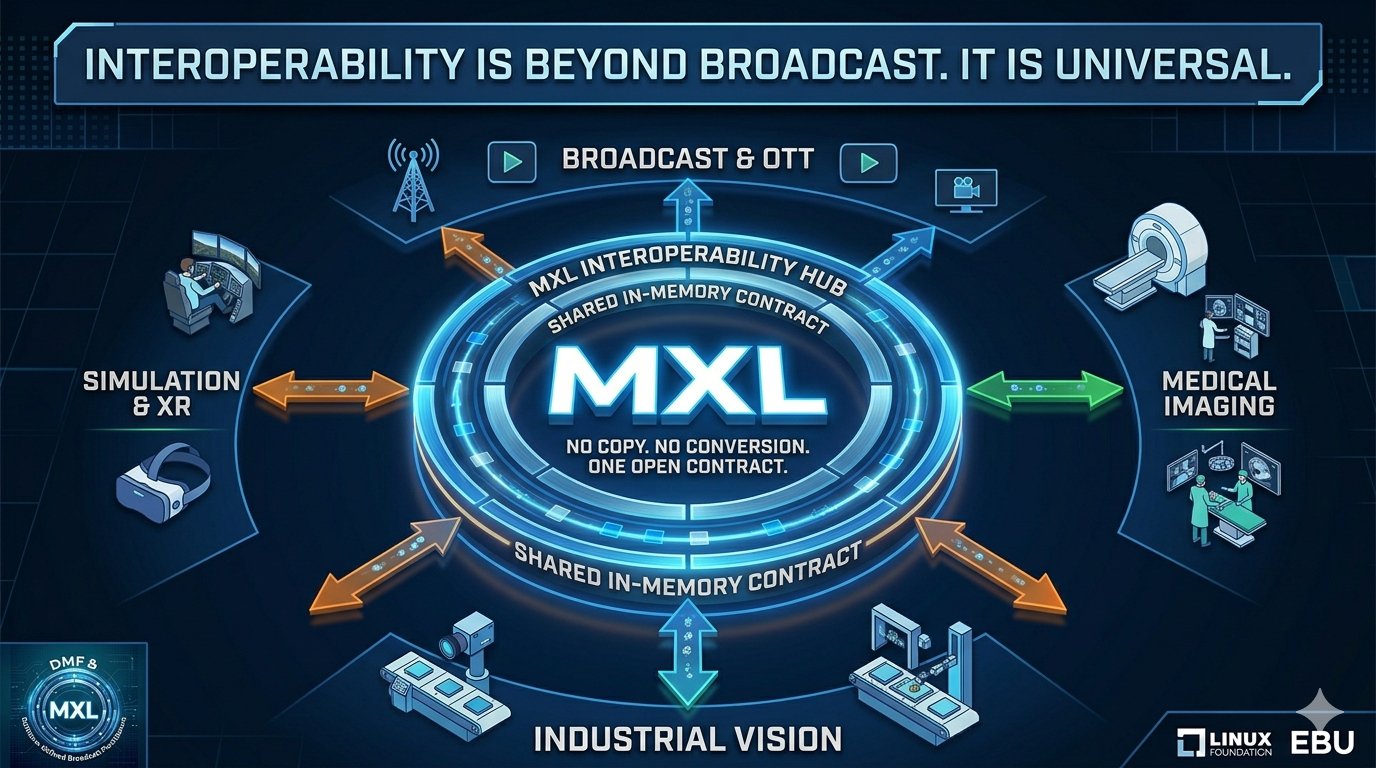
- High interoperability & in-memory performance: Through the MXL SDK, software applications from different vendors exchange uncompressed media data directly via shared memory with extremely low latency. Broadcast customers thereby save a large share of the costly integration effort.
The Best of Both Worlds: An Efficient Hybrid Cloud Model
A key characteristic of the overall architecture is its intelligent hybrid cloud concept:
- Base load covered on premises: The 365-day base load stays cost-efficiently in your own local data center.
- Dynamic cloud scaling: Live events with extreme load peaks, such as sports coverage, are offloaded flexibly to the cloud.
- Bandwidth optimization & image quality: Thanks to the reduced bandwidth requirements of the intermediate format, the system combines top technical performance during the transfer to the cloud with significant savings. This guarantees the best possible conditions for outstanding distribution image quality at minimal infrastructure cost.
Cloud-Native Advantages at a Glance
- Maximum scalability: Container orchestration allows processing power to be adjusted dynamically to the production workload.
- Simplified maintenance: Continuous deployment and automated updates reduce downtime and administrative effort to a minimum.
- Sustainable investment protection: Unlike device-bound hardware, the software logic is not tied to fixed replacement cycles; continuous updates keep it permanently up to date.
Winner of the IBC2026 Innovation Awards
As an active contributor from Wavelet Beam to this forward-looking technology approach, we are delighted that the open-source Media eXchange Layer (MXL) project has won the renowned IBC2026 Innovation Award in the Content Creation category. A huge thank you to the EBU, CBC/Radio-Canada, NABA, the Linux Foundation, NVIDIA and all participating partners. This recognition underlines the pioneering significance of MXL and DMF for the entire broadcast industry.
Current Implementation
The current version operates with Host Memory, delivering full IRIS denoising quality within the MXL pipeline.
Next step: Direct integration with the MXL Device Memory Ringbuffer, removing the host memory round-trip and unlocking the full performance potential for GPU-native, zero-copy denoising at scale.
About Wavelet Beam
Wavelet Beam is a leading specialist in GPU-accelerated video processing technologies. As an active contributor, Wavelet Beam helps shape forward-looking open-source initiatives and standards for software-defined media infrastructures.
A Leap in Efficiency with IRIS: Major Savings in Bandwidth and Bitrate
As a central building block in modern software-defined video pipelines, Wavelet Beam’s core technology IRIS comes into play. IRIS resolves one of the biggest bottlenecks in video distribution: disruptive image noise and grain:
- Precise noise management: IRIS separates unwanted noise from genuine image detail with high precision and lifts the signal out of the noise floor.
- Massive bitrate savings: By reducing erroneous motion vectors and visual disturbances, encoders have to process considerably less redundant data. This enables bitrate savings of up to 30 %, at the same or even improved perceived visual quality.
- Optimal distribution quality: Whether live broadcast, streaming or archive VOD: IRIS delivers clean master signals and creates the perfect basis for maximum compression efficiency along the delivery path.
Technical Background
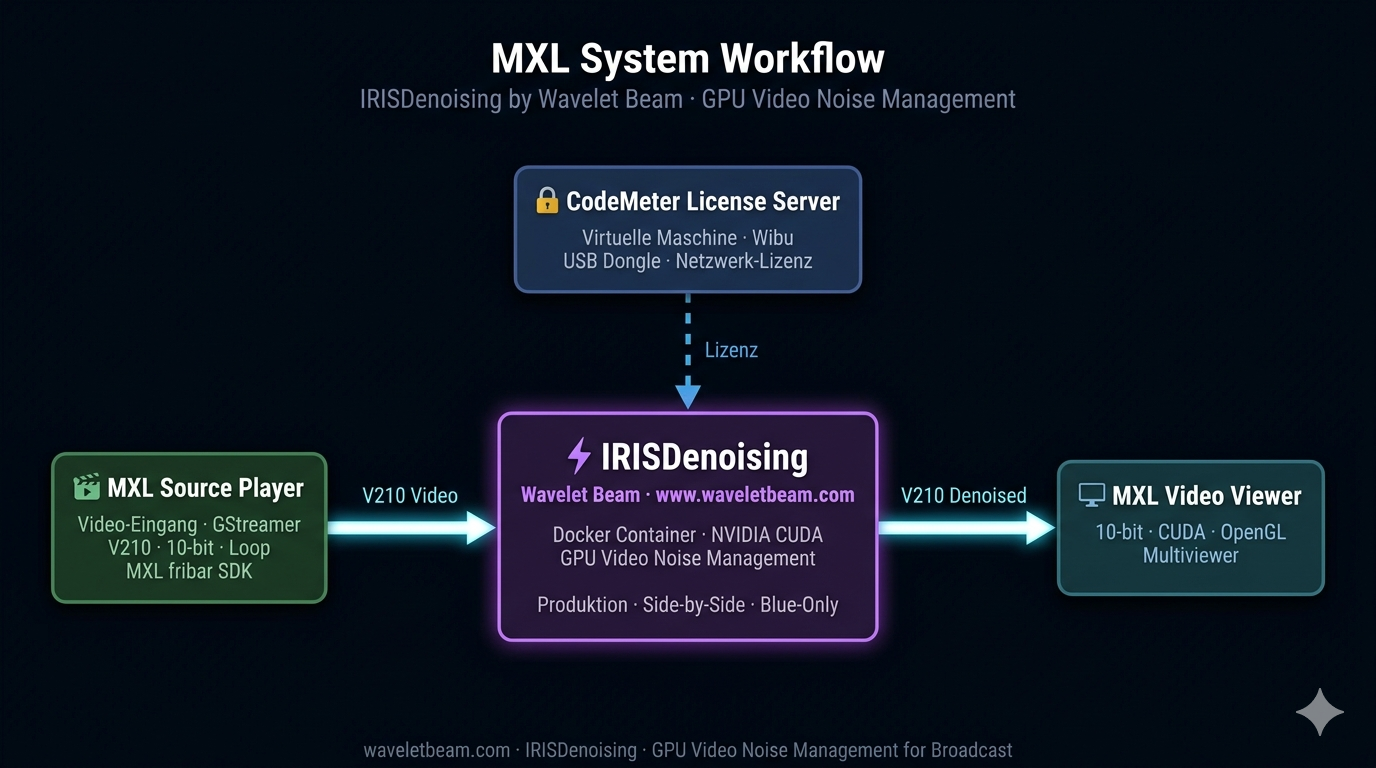
Wavelet Beam has implemented a first version of IRIS Video Denoising using the MXL SDK. IRIS runs as a standalone MXL Media Function inside a Docker container, fully integrated into the MXL infrastructure and ready to process live video streams with GPU-accelerated noise management.
MXL Workflow
Infrastructure
The deployment comprises five MXL applications, each running as a standalone Media Function in its own Docker container:
- SDI to MXL Bridge: Ingests SDI video streams via the Blackmagic DeckLink SDK and exposes them natively as MXL flows.
- IRIS-Denoising: GPU-accelerated real-time processing. The container encapsulates the complete IRIS denoising pipeline and cleans up live sources at the highest image quality, before intermediate formats for post-production are generated.
- GPU UHD Video Recorder: GPU-accelerated recording of MXL flows up to UHD resolution.
- 10-bit Uncompressed Viewer Application: For presenting uncompressed media pipelines in real time.
- Video Player: Real-time playback of MXL flows inside the fabric.
All applications share a common licensing component:
- CodeMeter License Server (VM): A dedicated virtual machine hosts the Wibu CodeMeter 8.40 service, providing licenses over the network via CmNet (Port 22350). Each container authenticates against this server on every start.